Back to case studies

Distribution · Life sciences An Israeli lab products importer and distributor

Every day, the open order book turns into purchase orders in SAP, by supplier and shipping mode

SAP Business One Import and distribution, three warehouses Running daily since September

2,263

open order lines checked in a single daily run

287

lines not ordered, because stock and orders on the way cover them

How we tell these stories

We tell every case the same way: not just the challenge and the result, but how we designed the flow and solved it step by step. In automation, the "how" is what holds up in production. So it's the part worth reading.

The challenge

The purchasing team went through every open customer order and its products by hand, and grouped them into purchase orders for the suppliers. It took between 6 and 10 hours a week.

The time did not go into typing. Every line needed a decision:

Hundreds of open lines at any moment, and each one goes through these four questions.

How we thought about it

The approach

The process does not decide for purchasing. It applies the decisions purchasing already made, to every line, every day. Each rule the team used to run in their heads became a gate in the scenario, and anything that fits no rule goes to a person.

01 · Three gates for every line

Order type, delivery date and stock. A line goes into a purchase order only after passing all three.

02 · Exceptions go to a person, not a guess

A delivery date on an unexpected weekday or a partial shortfall is never resolved automatically. The line moves to a review list and waits for a purchasing decision.

03 · Every line ends in a bucket

Ordered, covered by stock, rejected, held or waiting for review. The daily report shows purchasing every bucket, so no line gets lost on the way.

How we built the logic

Inside the scenario

The scenario runs once a day at a fixed time. The client's SAP sits on a local server, and Make reaches it through the On-Prem Agent, without exposing it to the internet.

The systems in the scenario

The steps

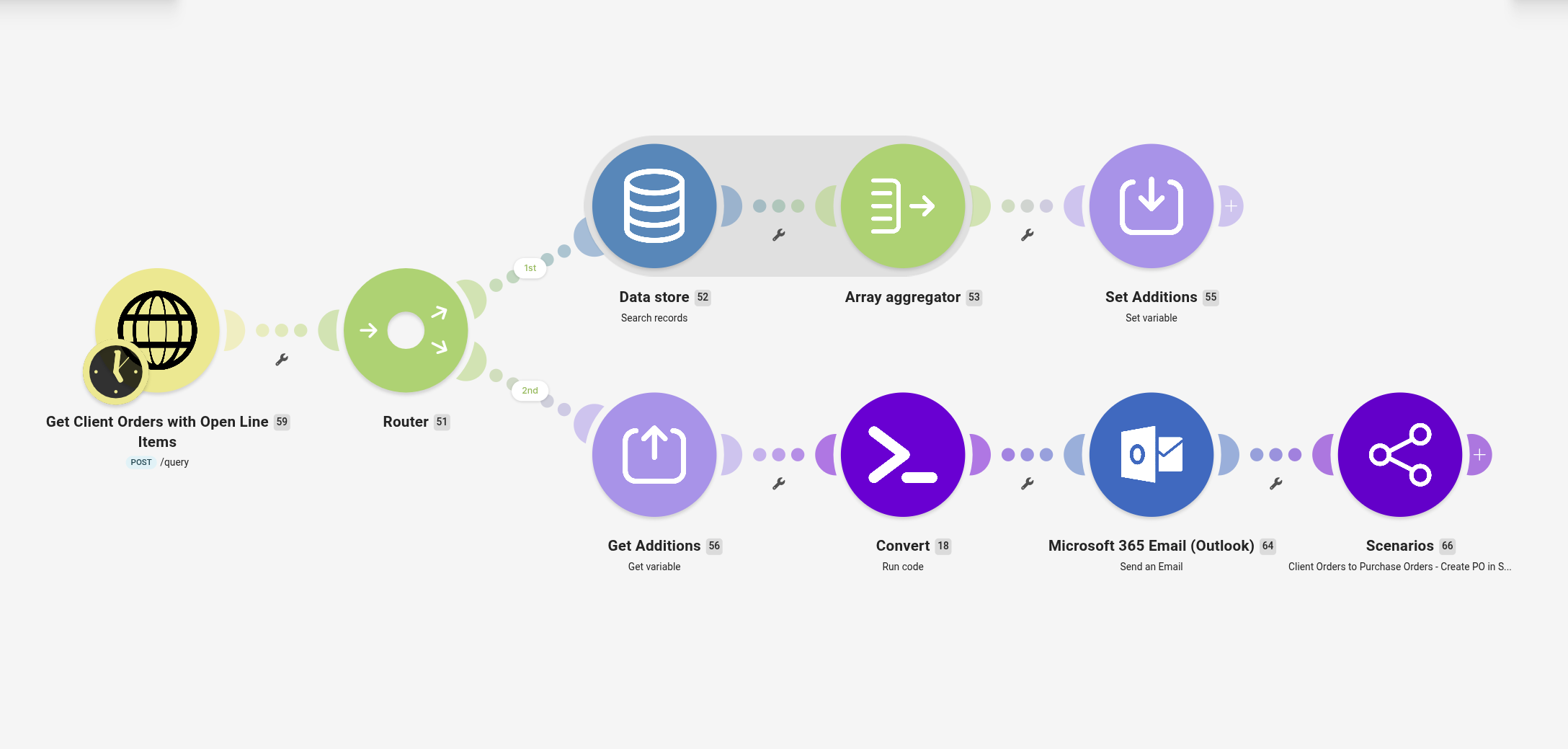
  1. One query to SAP pulls every open order line for the suppliers, with stock data.
  2. The team's additions are pulled and attached to their lines.
  3. The order type gate classifies each line: continue, reject, hold or review.
  4. The date gate: Sunday delivery goes by sea. Thursday delivery goes by air, only within a 40-day window. A past date goes to manual handling, and any other day goes to review.
  5. The stock gate checks stock and orders on the way against committed quantity. Customers with shelf-life requirements bypass it.
  6. Lines that pass are grouped into one purchase order per supplier and shipping mode. One supplier gets a further split by product type, including a separate order for hazardous materials.
  7. An Excel report with every bucket goes to purchasing.
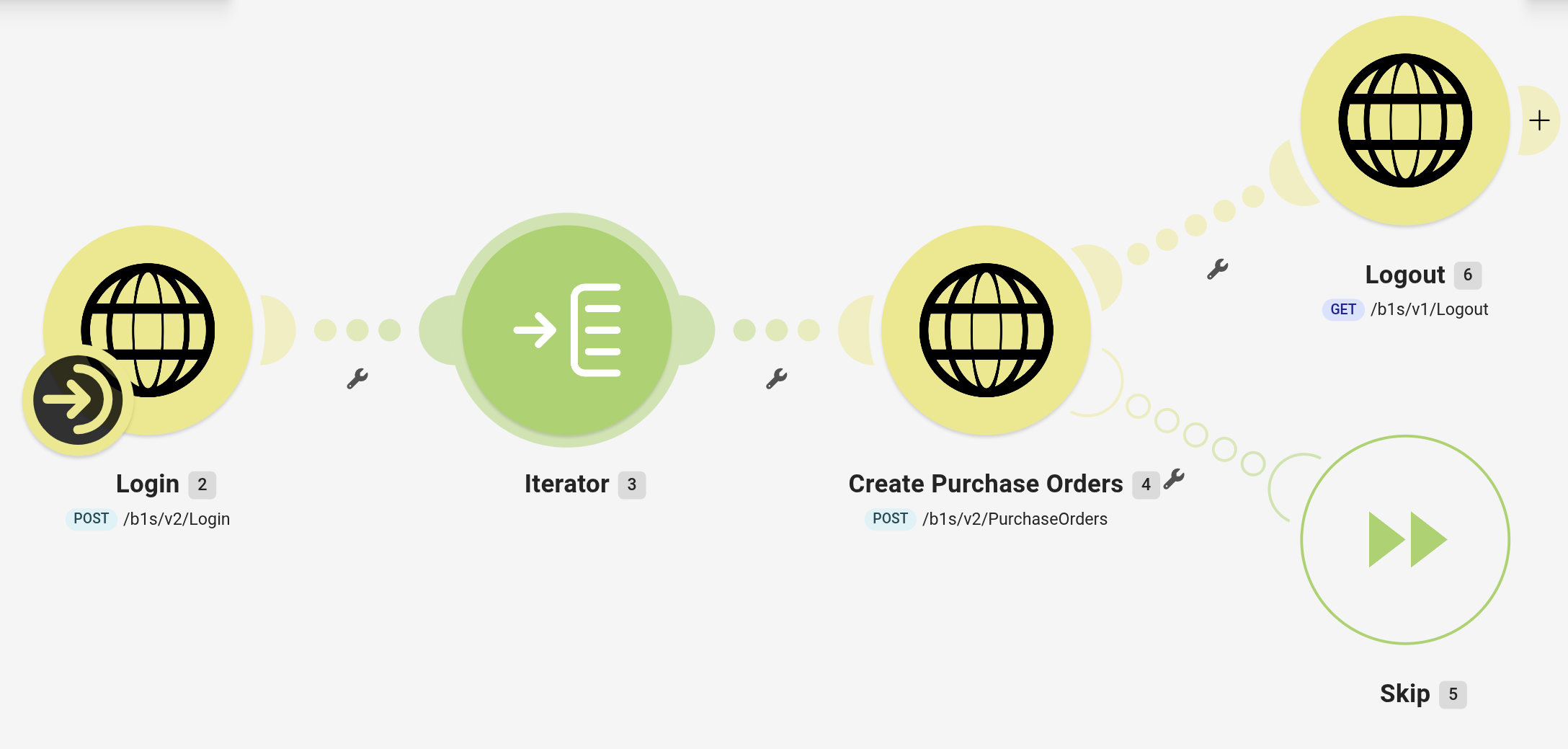
  8. A sub-scenario logs in to SAP, creates the purchase orders and logs out.
Make scenario: pulling open customer orders from SAP and calculating purchase ordersMake sub-scenario: creating the purchase orders in SAP

Why it would not have been built well otherwise

SAP runs on a local server

A cloud tool cannot reach it without opening the server up or building an API layer for it. The On-Prem Agent connects Make to SAP without exposing the server to the internet.

The rules belong to purchasing, not to the system

Shipping days, the 40-day window, shelf life and the hazardous materials split were all updated during the project. Custom development inside SAP would have locked them into code only an SAP developer touches. Here they sit in one module on the canvas, and change without touching the system.

One read instead of an export

A single query brings orders, stock, committed quantities and orders on the way, across three warehouses. No export to Excel and no manual cross-checking.

The results

The numbers are from a single run. Every run rescans all open orders.

Why Make Enterprise

Have an internal process like this?

A process that eats people's time but has no clear owner to build for it. That's exactly what Make Enterprise solves.