Cybersecurity · InfoSec Global Israeli cybersecurity company
Reclaiming meeting rooms with Slack-native automation
OT / IoT / IoMT 1,500+ employees In production since January 2026

Cybersecurity · InfoSec Global Israeli cybersecurity company
OT / IoT / IoMT 1,500+ employees In production since January 2026
of "ghost" meeting rooms released automatically, every day
rooms freed daily out of 18 ghost bookings, across 33 rooms and 49 users
We tell every case the same way: not just the challenge and the result, but how we designed the flow and solved it step by step. In automation, the "how" is what holds up in production. So it's the part worth reading.
The company grew fast, and with growth came a familiar pain: meeting rooms booked but never used.
As the organization scaled, room allocation became an operational bottleneck. Some rooms were also converted to permanent team use, shrinking availability further. The result: rooms that show as busy in the calendar but sit empty in practice - "ghost rooms" - while other employees hunt for a place to meet.
This wasn't a general shortage of rooms. It was that a quarter of bookings were "dead" while the rooms stayed occupied on paper. When it's the 10 popular rooms, even a quarter of ghost bookings creates a constant queue.
How we thought about it
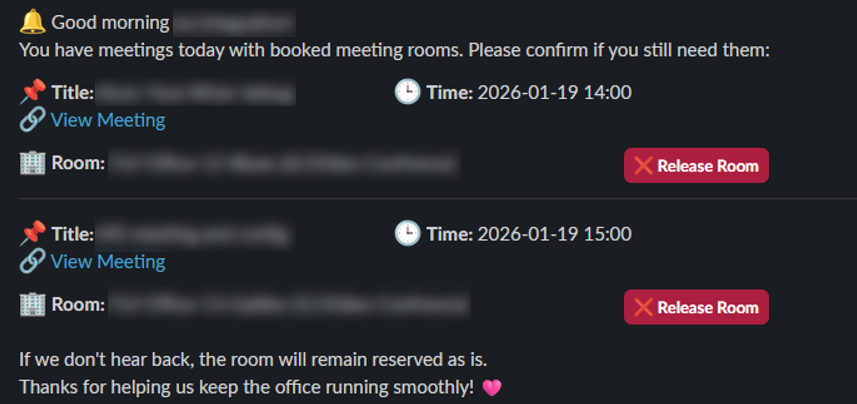
A Slack bot that runs automatically every morning, sends each meeting organizer a personalized reminder of the rooms they booked for that day, and lets them release the rooms they don't need with a single click.
The thinking behind it: instead of building a new system, we connected the three systems the client already uses - Zoom Rooms, Google Calendar, and Slack - into one scenario that handles the entire flow.
One consolidated message per person. An organizer with 3 meetings gets one message with 3 lines, not three pings.
"Release Room" frees the room automatically in Google Calendar. The meeting itself stays; only the room allocation is dropped.
No response means the room is kept as-is. No one loses a room through simple inattention.
How we built the logic
This isn't a simple webhook. It's a full business process with real logic.
Fully interactive inside Slack: the user never leaves. No external app to install, no separate system to log into. One button, one action in the calendar.
Three coordinated integrations, conditional logic (C-level detection, EA mapping, timezone, consolidating bookings per person), and state to maintain, all beyond the scope of basic point-to-point automation.
Every change to the monitored-room list, the EA list, or the routing logic would need a deployment. In Make Enterprise, changes happen in a visual builder, with no deployment.
Who's in which meeting, who the organizers are, who the executives' EAs are. Make Enterprise keeps the data inside the client's own environment, with no third-party intermediary.
“
Thanks to the automation, an average of 14 meeting rooms are released every day, which significantly eases our shortage of available rooms. Rooms that used to sit "booked" are available to employees again. The result is better room availability and more responsible behavior among our people.
Business Applications Manager, Global Israeli cybersecurity company
A process that eats people's time but has no clear owner to build for it. That's exactly what Make Enterprise solves.